Tetris and the Brain
Using PartyTris to Explore Psychology and Wellbeing
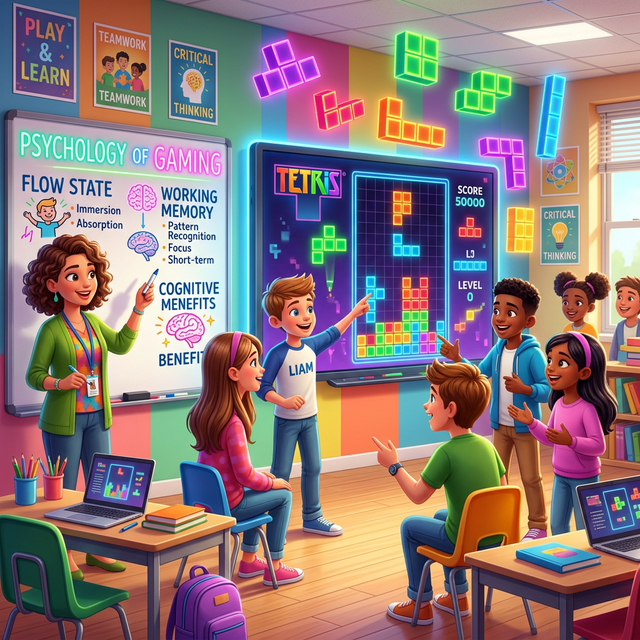
What is PartyTris?
PartyTris is a browser-based educational version of Tetris designed specifically for classroom activities and psychological exploration.
Modes for Education:
- Slowtris Mode: Slow falling blocks, ideal for focus and relaxation experiments.
- 2 Player / Party Mode: Collaborative or competitive play for communication skills.
- 1 Player Mode: High-stakes speed for testing resilience and flow state.
Why Tetris?
Tetris is one of the most studied games in clinical psychology. It offers a unique window into how our brains manage high-load visual tasks.
- Focused Attention: Blocks external distractions.
- Flow State: Creates perfect balance between challenge and skill.
- PTSD Research: Known to reduce intrusive visual memories.
- Spatial Reasoning: Engages the visual-spatial working memory.
The Stress Experiment
The Question:
Does playing steady-state Tetris actually reduce physiological stress?
Activity:
- Students self-rate their stress level on a scale of 1 to 5.
- Play Slowtris Mode for exactly 5 minutes.
- Re-rate stress levels immediately after.
Discussion:
Did the "Flow State" block out stressful thoughts? Was the repetition calming or frustrating?
The Team Chaos Challenge
Focus: Communication & Teamwork
Students work in groups of three with rotating roles:
- Player: Hands on the controls.
- Navigator: Tells the player where to move and rotate.
- Observer: Logs successes and communication breakdowns.
Play 3-minute rounds in 1 Player Mode or 2 Player Local.
The Frustration Tournament
Focus: Resilience & Strategy
Use 1 Player Mode with a 5-minute timer. Have students play two back-to-back rounds.
Reflection:
- What specific mistakes led to a "tower crash"?
- How did you adapt your strategy in the second round?
- Did you get "The Tetris Effect" (seeing the next piece before it falls)?
The Tetris Brain Trick
Test the limits of Visual-Spatial Working Memory:
- Instruct students to imagine a detailed favorite food for 30 seconds.
- Play Slowtris Mode for 3 minutes.
- Attempt to re-visualize that same food.
The Science:
Since Tetris and mental imagery share the same brain resources, the game often "erases" or dims the mental image.
The "Tetris Effect"
The brain is highly plastic. After playing, many people experience:
- Mentally arranging objects (bookshelves, groceries) into shapes.
- Visualizing falling blocks while falling asleep.
- Automatic pattern recognition in the real world.
Ready to Start?
Launch the classroom lab directly:
Launch PartyTrisURL for students: https://jamesabela.github.io/PartyTris/